Barbaresco vs Barolo: what really separates Piedmont's two great Nebbiolo wines
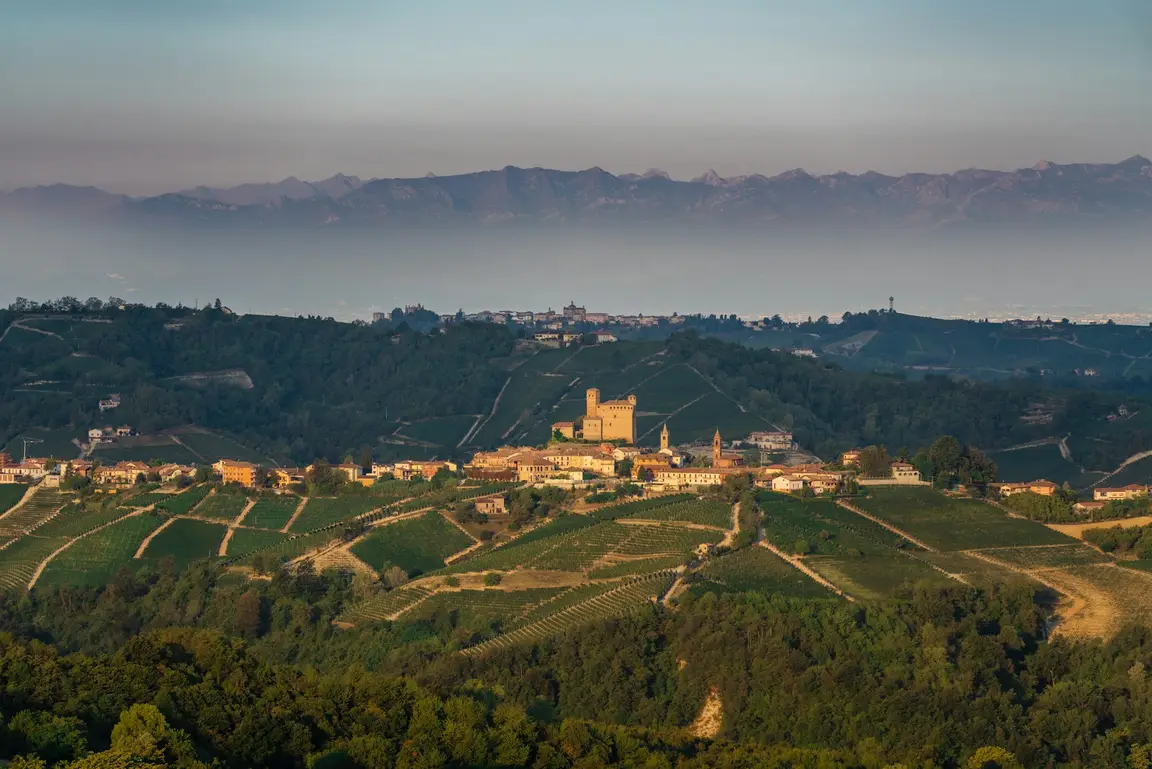
Is Barbaresco the same as Barolo? Not quite. Both are red wines made only from the Nebbiolo grape in the Langhe, the hills around the town of Alba in southern Piedmont (province of Cuneo, north-west Italy). Both became DOC in 1966 and DOCG in 1980. DOCG, Denominazione di Origine Controllata e Garantita, is the top tier of Italy’s wine classification.
The difference between Barolo and Barbaresco comes down to four things: where the grapes grow, how long the wine must age before release, its minimum alcohol, and how much of it is made. Barolo comes from eleven villages south of Alba, Barbaresco from three villages and part of Alba itself, north-east of the town. Barolo waits one year longer and needs half a degree more alcohol.
Style then depends on vineyard, vintage and producer. Wine Folly puts the main difference in the tannin, which in Barbaresco “won’t hit you quite as hard”; the Barbaresco rulebook calls its wine “velvety” and “properly tannic”.
In short
- Both are 100% Nebbiolo, DOC since 1966 and DOCG since 1980, with the same maximum yield of 8 tonnes of grapes per hectare.
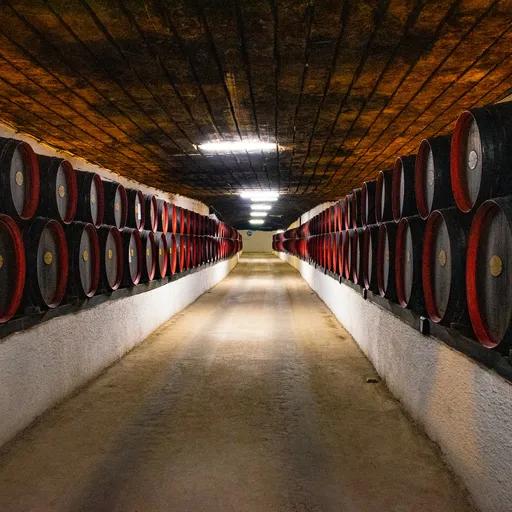
- Barolo ages at least 38 months, 18 of them in wood, and is released from 1 January of the fourth year after harvest. Barbaresco ages at least 26 months, 9 in wood, and is released from 1 January of the third year.
- Minimum alcohol: 13% for Barolo, 12.5% for Barbaresco.
- In 2024, 13.75 million bottles of Barolo and 4.3 million of Barbaresco were bottled (Valoritalia data).
What is the difference between Barolo and Barbaresco?
Every Italian appellation has a disciplinare, the production rulebook that sets the area, grapes, yields and ageing. Read side by side, the Barolo and Barbaresco rulebooks (in the consolidated text published by the producers’ consortium, last amended by ministerial decree on 17 April 2015) are built almost identically. Only a few numbers change, but they are the ones that matter.
The grape is the same: both require vineyards “composed exclusively of the Nebbiolo variety” (art. 2). So Barolo and Barbaresco are not two grapes, but two areas with two sets of rules for the same grape. If your question is rather Barolo against a wine simply labelled Nebbiolo, we cover the difference between Barolo and Nebbiolo separately.
The half-degree alcohol gap applies to the grapes too: Barolo grapes need at least 12.5% natural alcohol, Barbaresco grapes 12%. As for volume, the consortium’s president, Sergio Germano, told ItaliaOggi that “Barbaresco is a third of Barolo” (our translation).
Where are Barolo and Barbaresco made?
Both areas sit in the hills around Alba, but on opposite sides of the town. The Barolo rulebook places the wine “a few kilometres south of the town of Alba”. The Barbaresco rulebook speaks of “three villages north-east of Alba”.
Barolo. The area covers all of Barolo, Castiglione Falletto and Serralunga d’Alba, and parts of Monforte d’Alba, Novello, La Morra, Verduno, Grinzane Cavour, Diano d’Alba, Cherasco and Roddi (art. 3). These are the eleven villages the consortium also lists. Vineyards must lie between 170 and 540 metres above sea level, and north-facing slopes are excluded for new plantings.
Barbaresco. The area covers all of Barbaresco, Neive and Treiso (which the rulebook notes was “formerly a hamlet of Barbaresco”), plus the part of the San Rocco Seno d’Elvio hamlet that passed to the town of Alba in 1957. Vineyards may not exceed 550 metres and north-facing slopes are excluded.
For both, the permitted soils are “clayey, calcareous and their combinations”, on hillsides only. The Barbaresco rulebook also draws a line inside its own area: the hills of Barbaresco and Neive give wines of “structure, tannic fullness and power” on one side and “softness, rich fruit and finesse” on the other, while the hills of Treiso give wines “more about finesse and elegance than structure”.
How long are Barolo and Barbaresco aged?
This is the sharpest difference. The ageing months are counted not from the harvest but from 1 November of the harvest year (art. 5 of both rulebooks).
| Barolo | Barbaresco | |
|---|---|---|
| Minimum ageing | 38 months, 18 in wood | 26 months, 9 in wood |
| Riserva | 62 months, 18 in wood | 50 months, 9 in wood |
| Earliest release | 1 January of the 4th year after harvest | 1 January of the 3rd year after harvest |
| Riserva release | 1 January of the 6th year | 1 January of the 5th year |
As an example, a 2022 Barolo can be released from 1 January 2026, a 2022 Barbaresco from 1 January 2025. The Riservas follow in 2028 and 2027.
The consortium’s own pages round this to “at least three years” for Barolo and “at least two years” for Barbaresco. The exact figures are the months in the rulebooks. These are legal minimums: many producers age their wines longer.
Barolo vs Barbaresco: comparison table
| Barolo | Barbaresco | |
|---|---|---|
| Appellation | DOC (decree of 23/4/1966), DOCG (decree of 1/7/1980) | DOC (decree of 23/4/1966), DOCG (decree of 3/10/1980) |
| Grape | 100% Nebbiolo | 100% Nebbiolo |
| Villages | 11: all of Barolo, Castiglione Falletto, Serralunga d’Alba; parts of 8 others | All of Barbaresco, Neive, Treiso; part of Alba |
| Vineyard altitude | 170-540 m | up to 550 m |
| Maximum grape yield | 8 t/ha (7.2 with MGA and “vigna”) | 8 t/ha (7.2 with MGA and “vigna”) |
| Wine yield | 70%, max 56 hl/ha | 70%, max 56 hl/ha |
| Minimum natural alcohol of grapes | 12.5% (13% with “vigna”) | 12% (12.5% with “vigna”) |
| Minimum alcohol of wine | 13% | 12.5% |
| Minimum ageing | 38 months, 18 in wood | 26 months, 9 in wood |
| Riserva | 62 months | 50 months |
| Release | 1 January of the 4th year | 1 January of the 3rd year |
| MGA (official crus) | Listed in art. 8 | 66 names in art. 7 |
| Bottles bottled in 2024 | 13.75 million | 4.3 million |
Minimum acidity (4.5 g/l) and minimum extract (22 g/l) are identical. The Barolo rulebook also covers Barolo Chinato (art. 7), an aromatised wine flavoured with cinchona bark that uses Barolo as its base.
Do Barolo and Barbaresco taste different?
For the legal minimum profile, both rulebooks use the same words: colour “garnet red”, aroma “intense and characteristic”, taste “dry, full, harmonious”. The law does not tell the two apart in the glass. The differences in style come through in the longer descriptions.
The Barbaresco rulebook describes wines “garnet red with orange reflections, with an ethereal, pleasant and intense nose, a dry, full and delicate taste, velvety, properly tannic”. The Barolo rulebook calls its wines “harmonious, structured and long-lived”.
In its profiles, the consortium credits Barolo with aromas recalling “small red fruits, cherries in spirit and jam”, with “rose and faded violet”, spices and sometimes “liquorice, cocoa, tobacco and leather”, and a palate with “elegant and complex tannins”. For Barbaresco it stresses “its aristocratic elegance and its aromatic complexity”, with raspberry, red-fruit jam, geranium and violet. (These quotations are our translations from the Italian.)
Wine Folly, in its own comparison, writes that both wines smell of roses and cherry and have a very long finish, and that the difference lies on the mid-palate: in Barbaresco “the tannin won’t hit you quite as hard”. Tannin is what dries your mouth in a young red; our explainer on wine tannins covers how to recognise it.
Wine Folly puts the difference down mainly to soil. Note, though, that both rulebooks describe the geology with the same text, in the section on the link with the territory: Tortonian marls, “grey-blue in colour”. Style differences are better read hill by hill and vineyard by vineyard than appellation by appellation.
Barolo and Barbaresco crus: the MGA system
MGA stands for menzioni geografiche aggiuntive, the official names of individual hills or vineyard areas that may appear on the label. They are Piedmont’s equivalent of crus. The consortium notes that they were delimited and written into the rulebooks in 2010.
The Barbaresco rulebook lists 66 of them in article 7, including Asili, Rabajà, Martinenga, Montestefano, Ovello, Pora, Rio Sordo and Starderi. The Barolo rulebook has a longer list in article 8, with names such as Brunate, Cannubi, Bussia, Cerequio, Rocche dell’Annunziata, Villero and Vignarionda, plus one village-level mention for each of the eleven villages (“del comune di Barolo”, “del comune di La Morra” and so on).
The labelling rules are the same for both:
- the MGA must appear directly below the appellation name, in type no larger;
- the word “vigna” followed by a vineyard name is allowed only together with an MGA, with a lower yield (7.2 t/ha) and separate vinification;
- the vintage is mandatory;
- terms such as “extra, fine, naturale, scelto, selezionato, vecchio” are banned.
How much do Barolo and Barbaresco cost?
There are no official retail price lists. The market data available covers production, stocks and wholesale prices. Prices below stay in euro, with their dates.
Bottles. According to Valoritalia data reported by ItaliaOggi (January 2025), 13.75 million bottles of Barolo were bottled in 2024 (+3.8% on 13.24 million the year before, after a peak of 15.8 million in 2021) and 4.3 million of Barbaresco, in line with 2023. In 2025 Barolo fell to 13.5 million. In the first eight months of 2026, according to a second ItaliaOggi article (September 2026), bottlings rose 5.7% for Barolo and 3.8% for Barbaresco.
Stocks. Ministry of Agriculture (Masaf) data cited by ItaliaOggi show cellar stocks rising since 2019 from 65 to 74.9 million bottles for Barolo (+15%) and from 19 to 21.8 million for Barbaresco (+14.7%). Doing the sum, that is roughly five years of bottlings sitting in cellars for both appellations.
Bulk wine. According to Ismea (ItaliaOggi, January 2025), over one year the price of bulk wine fell from €9 to €7.90 per litre for Barolo (-12%) and from €7 to €5.85 for Barbaresco (-16%). In July 2026 Gambero Rosso reported, from Cuneo Chamber of Commerce data, bulk 2022 Barolo at €6.40-6.80 per litre, “one of the lowest prices in recent years”. These are wholesale prices between wineries, not what a shopper pays for a bottle.
Vineyards. According to preliminary 2025 data from the land market survey by CREA, Italy’s public agricultural research council, published by WineNews on 9 November 2026, a hectare of Barolo DOCG vineyard is worth from €350,000 up to €2.3 million, the highest value in Italy. Next come Alto Adige vineyards around Lake Caldaro, from €600,000 to €1.1 million, then Bolgheri (€300,000 to €1 million) and Montalcino (€250,000 to €1 million). The survey gives no figure for Barbaresco.
In the shop. As a rough guide only, Wine Folly (article updated December 2020) wrote that it is not uncommon to see both wines reaching towards $90 or more a bottle in the US. That is a six-year-old American price.
Finally, for the 2026 harvest, yields of Langhe Nebbiolo and Barbera d’Alba were cut by 10%, but not those of Barolo and Barbaresco, which stay at 80 quintals (8 tonnes) per hectare as the rulebooks allow (Gambero Rosso, July 2026).
Barolo or Barbaresco: which should you buy?
The rules already point the way.
If you want to open it sooner, Barbaresco starts ahead. It is released a year earlier and its own rulebook calls it “velvety” and “properly tannic”. The consortium writes that it “reaches its best between 5 and 10 years but can be much longer-lived”.
If you want a bottle to cellar, Barolo is built for it. More compulsory time in wood, a later release, higher minimum alcohol, and a rulebook that calls it “long-lived”. If you plan to keep bottles for years, see our guide on how to store wine.
If you want something less common, Barbaresco is scarcer. With about a third of Barolo’s bottles, it turns up less often on shelves. It is also cheaper in bulk, but the shop price depends mostly on the producer and the MGA.
If it is a gift, both work. Look at the vintage and the MGA on the label more than at the appellation. More ideas are in our guide on what wine to gift.
If your choice is between Piedmont and Tuscany instead, the next comparison is Barolo vs Brunello, Nebbiolo against Sangiovese.
Sources
- Disciplinare di produzione DOCG Barolo (consolidated text, last amended D.M. 17.04.2015) - Consorzio di Tutela Barolo Barbaresco Alba Langhe e Dogliani, accessed 11 November 2026
- Disciplinare di produzione DOCG Barbaresco (consolidated text, last amended D.M. 17.04.2015) - Consorzio di Tutela Barolo Barbaresco Alba Langhe e Dogliani, accessed 11 November 2026
- Barolo DOCG - Consorzio di Tutela Barolo Barbaresco Alba Langhe e Dogliani, accessed 11 November 2026
- Barbaresco DOCG - Consorzio di Tutela Barolo Barbaresco Alba Langhe e Dogliani, accessed 11 November 2026
- Il Barolo torna a crescere in bottiglia. E chiude il 2024 con un +3,8% - Emanuele Scarci, ItaliaOggi, 29 January 2025
- Rush dei vini piemontesi. Più imbottigliamenti nelle sei denominazioni - Emanuele Scarci, ItaliaOggi, 30 September 2026
- Anche nelle Langhe scattano i tagli alla produzione di vino. Barolo e Barbaresco (per ora) restano esclusi - Gambero Rosso, 2 July 2026
- In Barolo and South Tyrol the most precious vineyards, then Bolgheri and Montalcino: Crea survey - WineNews, 9 November 2026
- The Difference Between Barolo vs Barbaresco - Madeline Puckette, Wine Folly, 12 March 2014, updated 2 December 2020
Topics
- barbaresco
- barolo
- nebbiolo
- langhe
- piedmont
- comparison